

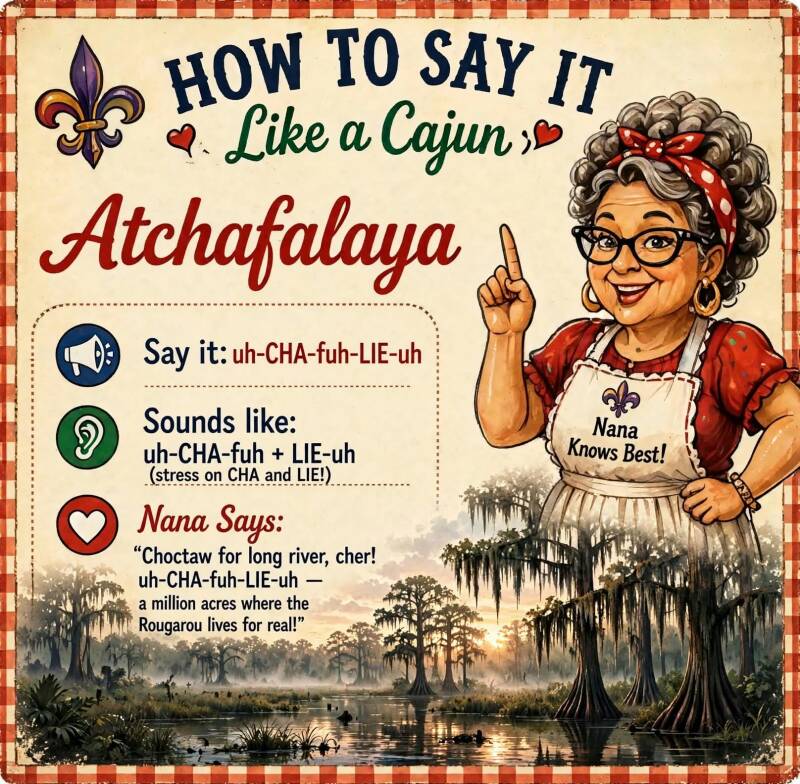
Rougarou Road Trip Stop #4: The Atchafalaya Basin — Where The Legend Was Born
Pronunciation First, Because I Know You Gonna Ask
Atchafalaya = uh-CHAFF-uh-LIE-uh. Say it fast, cher — uh-CHAFF-uh-LIE-uh. It's Choctaw for "long river."
And baby, it's a million acres of long, dark river swamp. The biggest river swamp in the whole United States.
If a Rougarou wanted to hide forever, this is where he'd do it.
👉 Shop Nana's Basin Safety Kit: Get it here
Why We End Here
Baby, Lake Maurepas is where he hunts oysters (Stop 2). Manchac Swamp is where Julia Brown sang him up (Stop 3). Frenier Landing is where we eat on top of the towns he watched wash away (Stop 3.5).
But Atchafalaya? That's his house. That's where the French Acadians who became Cajuns first heard Choctaw and Houma people talk about a big wolf that walked like a man — and called it Loup-Garou. Then we Cajun-ized it to Rougarou.
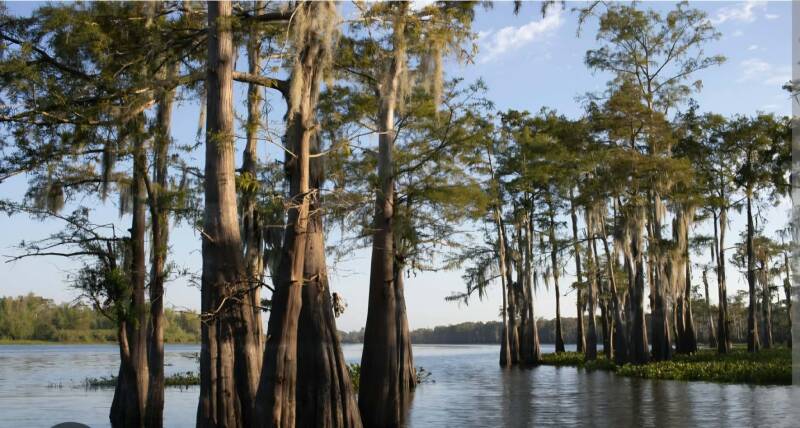
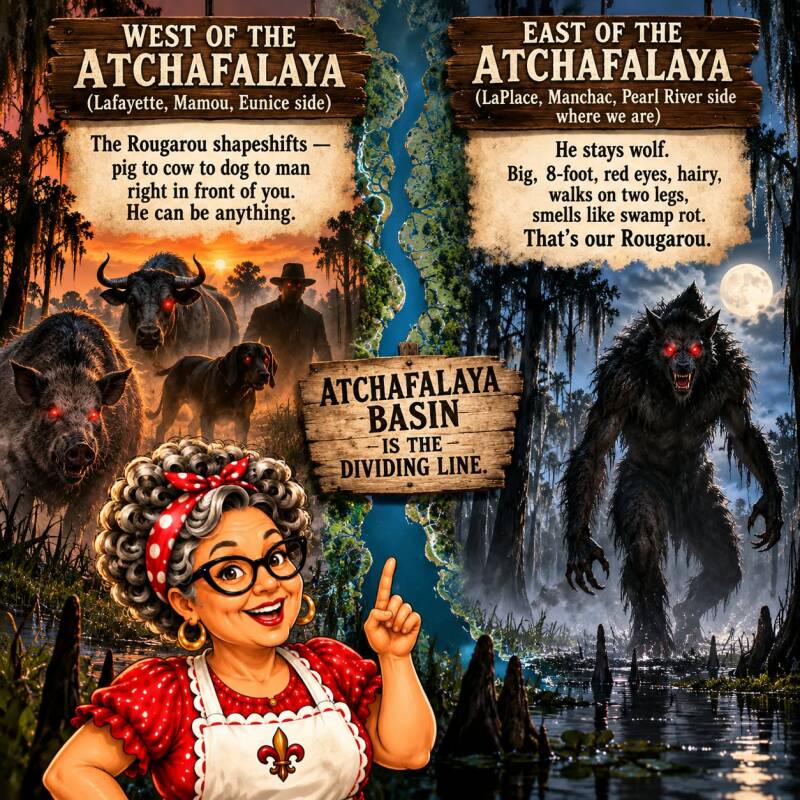
And there's a difference the old people east vs. west of the Atchafalaya will argue about all night over beer:
West of the Atchafalaya (Lafayette, Mamou, Eunice side): The Rougarou shapeshifts — pig to cow to dog to man right in front of you. He can be anything.
East of the Atchafalaya (LaPlace, Manchac, Pearl River side where we are): He stays wolf. Big, 8-foot, red eyes, hairy, walks on two legs, smells like swamp rot. That's our Rougarou.
Atchafalaya is the dividing line. That's why we end here — to show both kinds.
4 True Atchafalaya Rougarou / Loup-Garou Stories Nana Collected For You
1. The 1897 Loggers — The One Who Never Came Back
This one is from the Atchafalaya cypress camps. A timber crew went in to mark cypress for a mill. Routine work. First night, forest went dead quiet — no frogs, no crickets. That's Sign #1 in the Basin — when the swamp goes silent, something bigger than a gator is watching.
They found tracks in mud — 18 inches long, half paw, half foot. Something circled their camp every night just outside the firelight. On night 4, one logger vanished. No blood, no fight. Just gone. Old newspapers didn't report it — companies didn't want to scare workers away from timber money. But his family still tells it in Henderson.
Nana says: If you find a track that starts as a wolf print and ends as a barefoot man — turn your boat around.
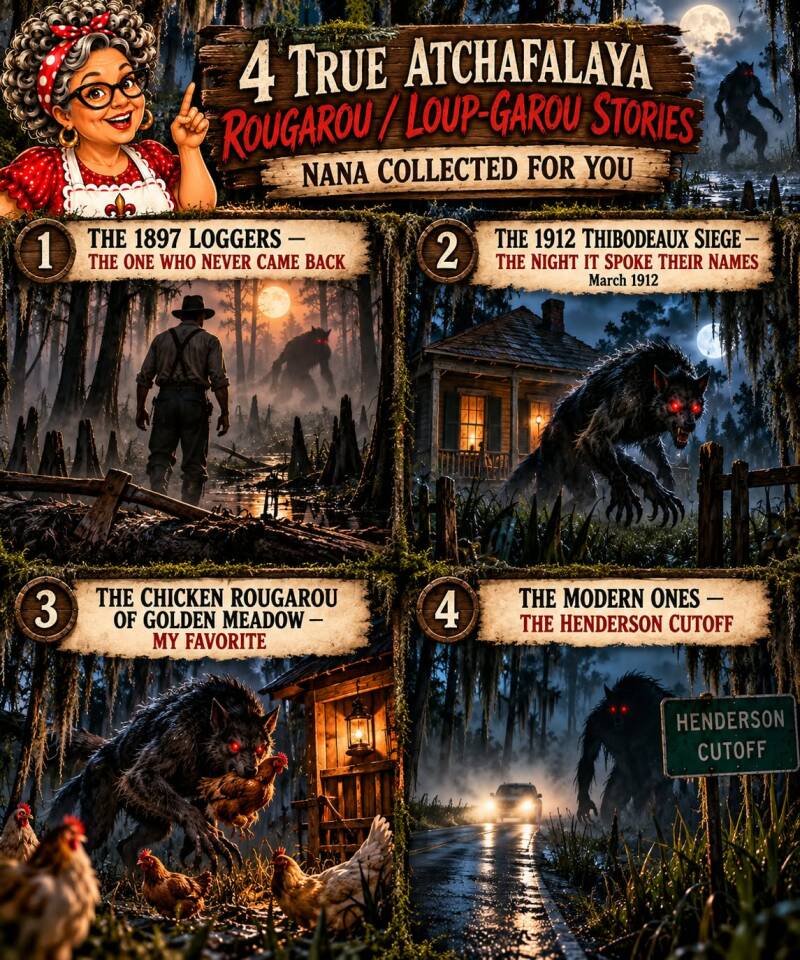
2. The 1912 Thibodeaux Siege — The Night It Spoke Their Names
March 1912, deep Basin near what is now Butte La Rose. The Thibodeaux family — Jean-Baptiste, Celeste, and little Marie — lived in a cypress cabin on stilts.
A storm wasn't coming, but all the animals left. Then it came. Big. Shredded cypress logs with claws. Circled the cabin. And cher, here's the part that makes my hair stand up — it spoke their names in their own voices. "Celeste..." in Jean's voice. "Marie..." in Celeste's voice.
It tried to drop through the roof. They only survived because Celeste had her grandmother's traiteuse trick — she put 13 small stones and a silver dime in the windowsills and poured salt across the threshold. It screamed like a man and left. Tulane supposedly has plaster casts of prints from that night in an archive — 13-inch, bipedal, clawed.
Every Basin family has a "siege night" story. This is the most famous.
3. The Chicken Rougarou of Golden Meadow — My Favorite
Not every Rougarou is 8 feet tall, cher! Nana Perrin's mother-in-law was shelling peas in her yard in Golden Meadow — just over the Basin edge — and a chicken started pecking her. Aggressive, mean, drew blood. She looked at that chicken and said "That's no chicken, that's a Rougarou." And she was right — in that family, a grumpy neighbor who was a known loup-garou had a thing for turning into mean animals to harass people.
Same with a deer hunter down in Dularge — shot an owl with an arrow. Next day, found a man in the same spot with an arrow in the same place. Hibou-garou — were-owl!
So if a chicken or an owl is acting real personal with you in the Basin — might not be a chicken.
4. The Modern Ones — The Henderson Cutoff
This is why I put Atchafalaya last. It's not just old stories.
Duck hunters in the Basin still report a leopard or panther that moves too fast, then stands up like a man. Windell Curole from Cut Off told that one.
Fishermen in 1883 wrote in logbooks about a wolf that followed their boats for 3 nights, left claw marks on hulls every morning — never attacked, just followed.
2026 trail cam photo from St. Mary Parish — game warden supposedly confiscated it. Big, bipedal, fast in mud. You can still find the blurred copy online.
And the protection is always the same: If you draw its blood, it turns back into a man and runs. That's why Cajun men always carried a pocketknife or sharp keys. If you cut a Rougarou, you break the curse for 101 days — but that man will remember you cut him.
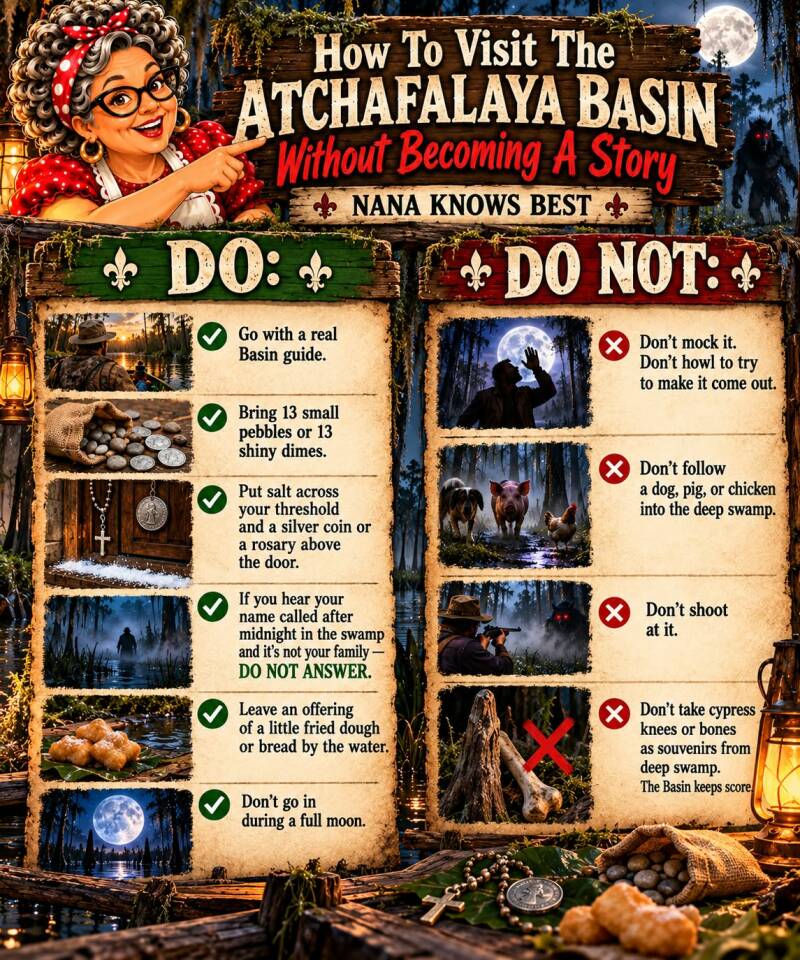
How To Visit The Atchafalaya Basin Without Becoming A Story — Nana Knows Best
This is NOT Manchac where you drive by. This is a MILLION acres. You don't just wander.
DO:
Go with a real Basin guide —
Atchafalaya Basin Landing Airboat Swamp Tours
McGee's Louisiana Swamp & Airboat Tours
Tell them you want the Rougarou tour — they got one, they just don't advertise it.
Bring 13 small pebbles or 13 shiny dimes. Old protection — put them in your pocket, windowsill of your cabin, or around your tent. Traiteuses swear by 13.
Put salt across your threshold if you stay in a Basin houseboat or cabin. And a silver coin or your great-grandma's rosary above the door.
If you hear your name called after midnight in the swamp and it's not your family — DO NOT ANSWER. That's the oldest Basin rule. It's mimicking.
Leave an offering of a little fried dough or bread by the water — same as we do for Julia. Shows respect.
DO NOT:
Don't go in during a full moon without a local. That's Loup-Garou night. Even gator hunters stay home.
Don't mock it. Don't howl to try to make it come out. T-Nick did that as a boy — grounded for a month and had nightmares for a year.
Don't follow a dog, pig, or chicken into the deep swamp. If an animal acts too smart and wants you to follow — it's not an animal.
Don't shoot at it unless you have silver — regular buckshot just makes him mad. And if you DO cut him and he turns into a man — don't tell who he is. You'll be cursed next.
Don't take cypress knees or bones as souvenirs from deep swamp. The Basin keeps score.
Where To Eat & Launch For Stop #4
Launch: Lake End Park in Morgan City, or Henderson at McGee's Atchafalaya Basin Tours — they know where the old logging camp was.
Eat After: Pat's in Henderson for crawfish étouffée, or Chicken on the Bayou if you want to laugh about the chicken Rougarou story.
Come at dusk. Listen when the frogs stop. If the swamp goes dead silent and your boat ripples with no wind — cher, that's your sign. Look at the treeline.
You might see those red eyes.
Nana's Final Note For The Road Trip
We started in Maurepas where he culls oysters. We went through Manchac where Julia sang the storm. We ate at Frenier where her table is still set.
And we end here in Atchafalaya — where the Rougarou was born from French and Choctaw words, where he still walks, where loggers disappeared and families survived sieges by using salt and silver.
Take your 13 pebbles home. Put one on your porch for protection.
And if someone acts real nasty to you after being out in the swamp late — check if he has a fresh cut. Might be your Rougarou for 101 days.
Frequently Asked Questions
Why does the Rougarou Road Trip end at the Atchafalaya Basin?
The Atchafalaya is where the legend itself was born — it's where French Acadian settlers first heard Choctaw and Houma people describe a wolf that walked like a man, "Loup-Garou," which the Cajuns later turned into "Rougarou." It's also the geographic dividing line between the two regional versions of the legend, so ending here shows both kinds of Rougarou at once.
What's the difference between the Rougarou east and west of the Atchafalaya?
West of the Atchafalaya (around Lafayette, Mamou, and Eunice), the legend says the Rougarou can shapeshift freely — pig, cow, dog, man, and anything in between. East of the Atchafalaya (LaPlace, Manchac, and Pearl River, where the rest of this road trip takes place), the Rougarou stays in one form: an 8-foot, red-eyed, two-legged wolf.
What should I do if I hear my name called in the Basin at night?
Old Basin rule: don't answer. If it's after midnight and the voice calling your name isn't a member of your own party, it's considered mimicry, and answering is how you invite trouble. This is treated as the single most important rule in the stories collected here.
Is it safe to visit the Atchafalaya Basin, or is this just for thrill-seekers?
It's absolutely visitable and worth the trip for the scenery and food alone, but it's a million-acre wilderness, not a roadside stop — go with a real local guide out of Henderson or Morgan City rather than wandering in on your own, especially avoiding a solo visit during a full moon.
What's the old protection against a Rougarou if you can't avoid an encounter?
Tradition says drawing its blood — even a small cut — forces it back into human form and breaks the curse on it for 101 days, which is why Cajun men traditionally carried a pocketknife or kept sharp keys on hand. The stories also warn that the man it turns back into will remember who cut him, so old folks say never to reveal who you recognize.
👉 Shop Nana's Basin Safety Kit: Get it here
Did you ever hear your name called in the Atchafalaya? Did you ever see a chicken that wasn't a chicken? Tell me below — Nana believes you.
More From Nana
That's the whole Rougarou Road Trip, cher — start over anytime:
- Stop 1: Honey Island Survival Kit [HERE]
- Stop 2: Lake Maurepas Stories [HERE]
- Stop 3: Manchac Swamp Curse [HERE]
- Stop 3.5: Julia's Table at Frenier Landing [HERE]
Rougarou Roadtrip: Nana’s Haunted Cajun Roadtrip Series
Add comment
Comments