

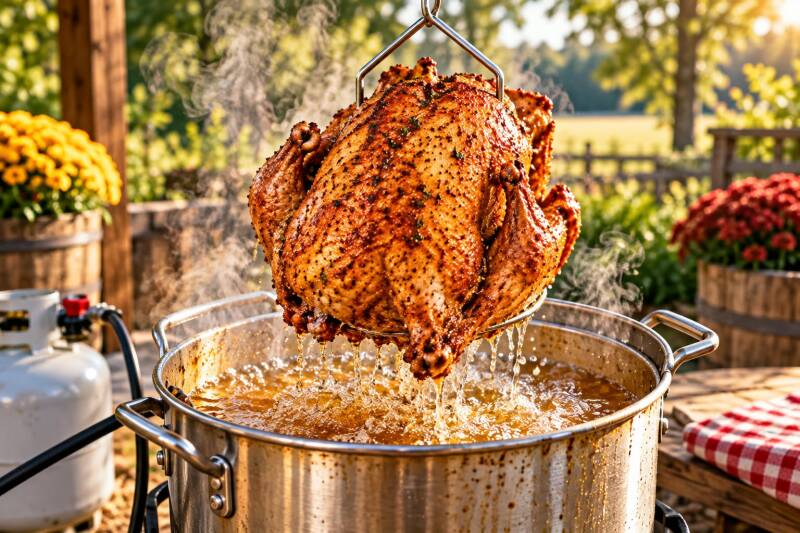
Cajun Fried Turkey Recipe: Crispy, Juicy + Safe
Down here in Louisiana, we don't bake our turkey, cher. We fry it. Crackly golden skin, juicy meat all the way to the bone, and it's done in a fraction of the time a roasted bird takes.
But I'm gonna tell you plain: a pot of 350-degree oil is the most dangerous thing in a Thanksgiving kitchen. Fire departments see turkey-fryer fires every single year, and plenty of us fried for decades the old way without a second thought. This recipe is the way I'd teach my own grandchildren to do it today, following what USDA, fire-safety groups and the fryer makers actually say.
Read the Safety First section before you buy a single thing. Then come back and let's fry.
Safety First (Please Read This Part, Cher)
Fire-safety organizations such as UL and the National Fire Protection Association (NFPA) actually advise against using oil-based turkey fryers at all, and they point to oil-less (infrared) fryers as the safer option.
A lot of us in Louisiana are going to fry anyway, so if you do, these are the published rules to follow every time:
Fry OUTDOORS only. Never in a garage, on a porch or deck, or under an overhang, and a safe distance from the house, trees and anything that can burn. Never in rain or snow.
Level ground, and don't move the fryer once it's going. Keep about 2 feet between the pot and the propane tank.
Thaw the turkey completely and dry it well, inside the cavity too. Ice or water hitting hot oil causes dangerous flare-ups and boil-overs.
Pick a smaller bird. USDA says whole turkeys up to 12 lb are suitable for frying; fire-safety guidance says 8 to 10 lb is best and to skip anything over 12 lb. That is why this recipe uses a 10 to 12 lb turkey, the top of the safe range. Go smaller if you can.
No stuffing in the bird, and avoid water-based marinades.
Measure your oil with the water test (below) and NEVER go past your fryer's MAX fill line. Overfilled oil spills onto the burner and catches fire.
Turn the burner OFF before you lower the turkey, lower it SLOWLY, then relight.
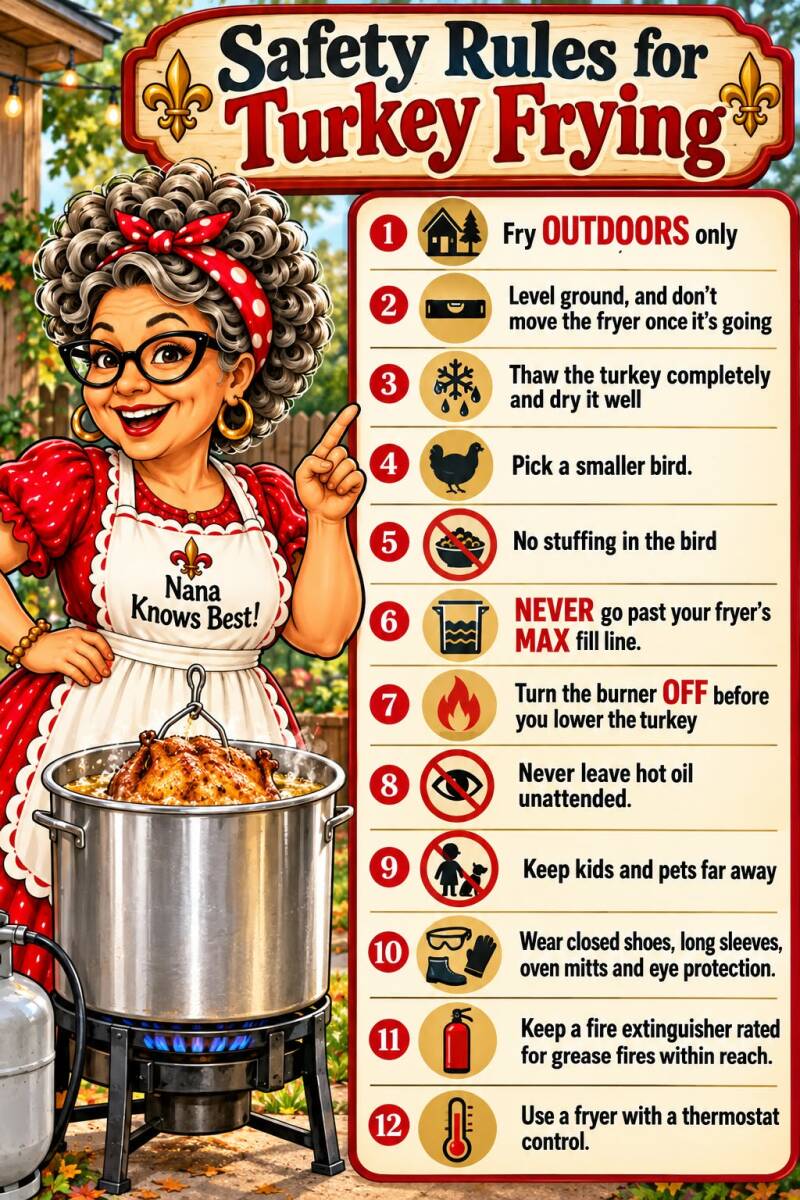
Never leave hot oil unattended. Watch the thermometer the whole time. If the oil starts smoking, turn the burner off.
Keep kids and pets far away from the fryer, the whole time, including while the oil cools.
Wear closed shoes, long sleeves, oven mitts and eye protection.
Keep a fire extinguisher rated for grease fires within reach. NEVER use water on an oil fire. If it gets out of control, get everyone away and call 911.
Use a fryer with a thermostat/temperature control and follow your fryer's instruction manual, which always beats my recipe if the two ever disagree.
Safety sources:
USDA FSIS, Turkey: Alternate Routes to the Table,
USDA FSIS, Deep Fat Frying and Food Safety,
NFPA, Thanksgiving safety tips, and
UL/NFPA turkey fryer tips (Delaware State Fire School).
Shop NanaTee’s Cajun Thanksgiving Kit
Allergy Notice: Peanut Oil
Traditional fried turkey uses peanut oil because it handles high heat well. Peanut oil can cause a serious reaction in people with a peanut allergy. Highly refined peanut oil is often tolerated, but cold-pressed or unrefined peanut oil is not, and cross-contact with food cooked in it can still be a risk. Ask every guest about peanut and tree-nut allergies before you plan the menu, and tell them what the turkey was cooked in. If anyone at the table has a peanut allergy, use a different oil with a high smoke point, such as refined canola or soybean oil, and keep the cooking utensils separate. When in doubt, talk to the guest's doctor.
Why Fry a Turkey?
It's fast. About 3 to 5 minutes per pound once the oil is hot, instead of hours in the oven.
Crispy skin, juicy meat. The hot oil seals the outside quickly.
It frees up your oven for dressing, casseroles and pies.
It's a Louisiana tradition, and standing around the pot with family is half the fun.
Ingredients
One 10 to 12 lb turkey — Yield: 21 to 26 servings (3 oz cooked meat each)
1 turkey, 10 to 12 lb, completely thawed, giblets and neck removed, patted very dry inside and out. Not stuffed.
Creole butter injection, about 10 to 12 oz total (pick one):
Homemade: 1 stick (4 oz, 1/2 cup) melted butter, 1/2 cup chicken broth, 2 Tbsp Tony Chachere's or Zatarain's Creole seasoning, 1 tsp garlic powder, 1 tsp Worcestershire sauce, and hot sauce to taste. Whisk until smooth.
Store-bought: 1 bottle (17 oz) Tony Chachere's Creole Style Butter Injectable Marinade. Most folks use about 3/4 of the bottle for a 10 to 12 lb bird.
1/2 cup Tony Chachere's Original Creole Seasoning, for the outside
1 tablespoon cayenne pepper
Peanut oil, enough to reach your fryer's fill line (usually 3 to 5 gallons; use the water test below to find YOUR amount). See the allergy notice above.
Equipment
Outdoor propane turkey fryer with a thermostat and a pot and basket/rack sized for your bird
Meat injector (wide-bore needle if your injection has seasoning bits)
Deep-fry or candy thermometer and an instant-read food thermometer
Grease-rated (ABC) fire extinguisher, oven mitts, closed shoes, eye protection
Paper towels, a roasting pan or large tray, and a cooler or covered pot for the cooled oil
Instructions
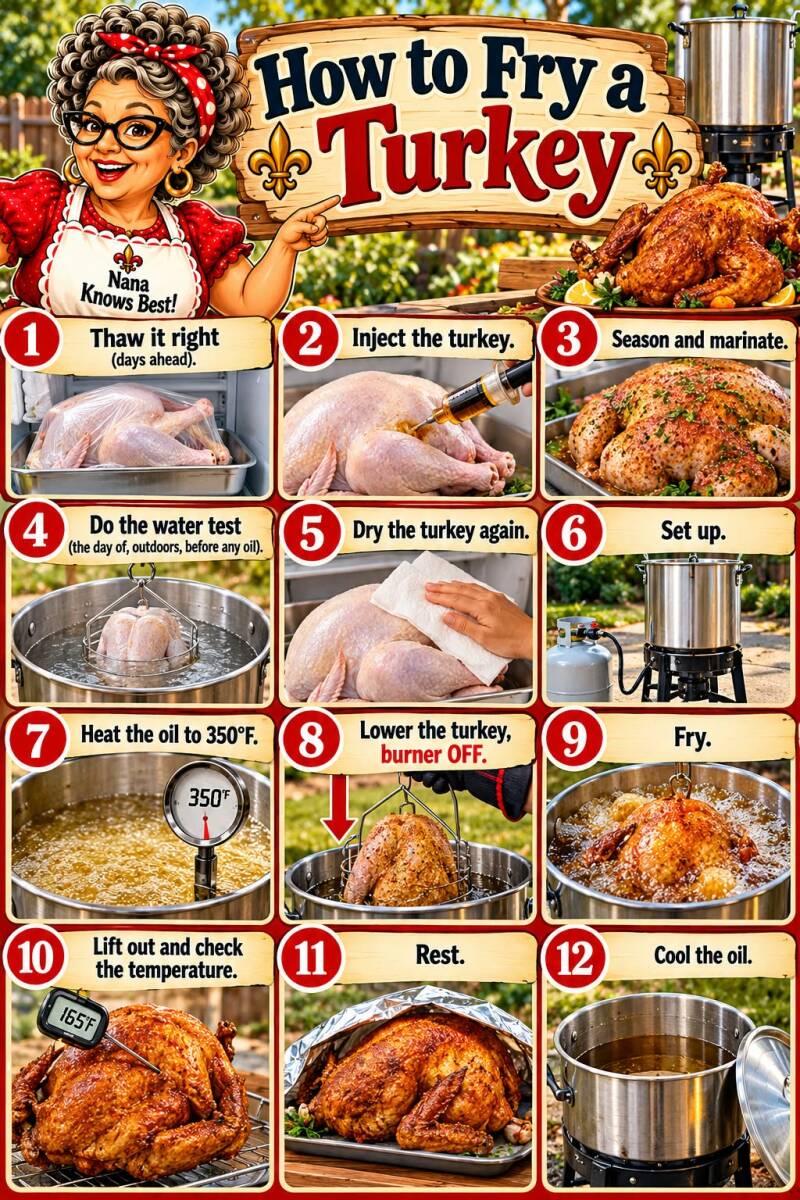
1. Thaw it right (days ahead). Thaw in the refrigerator, allowing about 24 hours for every 4 to 5 pounds. A 12 lb turkey needs about 2 1/2 to 3 days. Don't thaw on the counter.
2. Inject the turkey. An injection puts the seasoned butter inside the meat, where the skin can't keep it. For a 10 to 12 lb bird, inject about 10 to 12 ounces total, spread all through the breast, thighs and legs, roughly 1 ounce per spot. Push the needle in slowly, release as you pull out, and wipe off whatever leaks. Most of that butter and salt stays in the meat. It don't cook out.
3. Season and marinate. Pat the outside dry, then rub the outside and cavity with the Creole seasoning and cayenne. Cover and refrigerate 12 to 24 hours.
4. Do the water test (the day of, outdoors, before any oil). Put the turkey in the empty fryer pot, add water until it just covers the turkey, then lift the turkey out. Mark that water level or measure the water. That is how much oil you need, but never fill past the pot's MAX fill line. If the water line is above the max line, your turkey is too big for that pot. Pour out the water and dry the pot completely.
5. Dry the turkey again. Take it out of the refrigerator and pat it very dry, inside the cavity too. Wet skin and oil don't mix.
6. Set up. Place the fryer on level ground outdoors, well away from the house and anything that can burn, with the extinguisher within reach. Add oil to the line you found in step 4.
7. Heat the oil to 350°F. Light the burner and watch the thermometer, never walking away. Keep the temperature at 350°F (if your fryer manual gives a different temperature, follow your manual). If the oil smokes, turn off the burner.
8. Lower the turkey, burner OFF. Turn the burner off. Wearing mitts and eye protection, slowly lower the turkey into the oil, a few inches at a time. If the oil is bubbling up near the rim, stop and wait for it to settle. Once the turkey is in, relight the burner and bring the oil back to 350°F.
9. Fry. Cook about 3 to 5 minutes per pound (see chart), holding the oil at 350°F. Never leave the pot.
10. Lift out and check the temperature. Turn the burner off, lift the turkey out slowly and let the oil drain from the cavity back into the pot. Place on a rack set in a pan. Check with a clean instant-read thermometer in the thickest part of the breast AND the innermost part of the thigh and wing. All must read at least 165°F. If any spot is under 165°F, carefully lower it back into the oil and fry a little longer, then check again.
11. Rest. Let the turkey rest 20 minutes before carving.
12. Cool the oil. Leave the lid on the pot, away from kids and pets, until completely cool (often overnight) before you strain or dispose of it.
Fry Time Chart
Turkey weight Approximate fry time (3 to 5 min/lb)
10 lb 30 to 50 minutes
12 lb 36 to 60 minutes
Time is a guide. The thermometer is the boss.
How To Serve & Store
To Serve: Carve and serve hot with dirty rice, dressing, mac and cheese, and plenty of gravy for the folks who need it.
To Store: Get leftovers into the refrigerator within 2 hours of cooking. Keep in shallow airtight containers up to 3 to 4 days, or freeze for longer. Reheat to 165°F.
Leftover oil: Strain and store cooled oil in a covered container in a cool place. USDA says strained, covered oil can be reused within about a month. Throw it out if it smells off, looks dark or foamy.
Nana's Tips
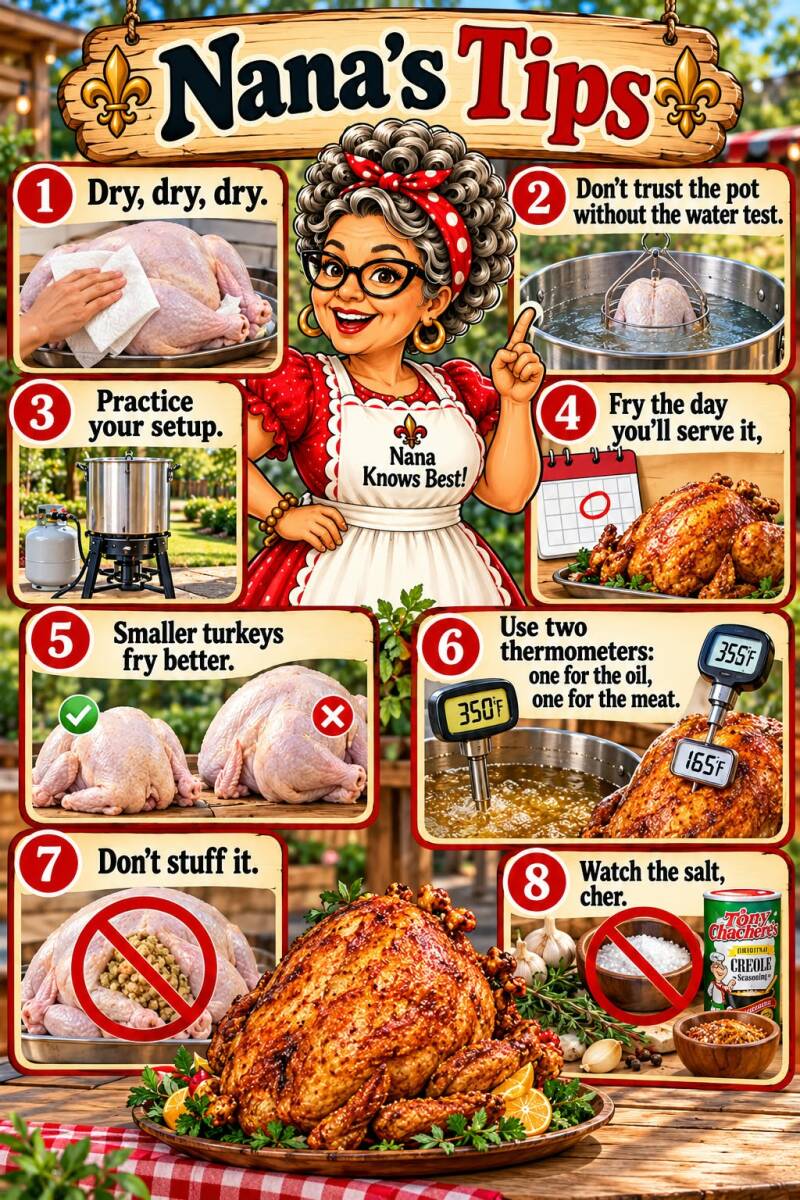
Dry, dry, dry. Wet turkey is the number one cause of boil-overs. Pat it down twice.
Don't trust the pot without the water test. Skipping it is how oil ends up on the burner.
Practice your setup once with water so you know where everything goes before there's a hot pot involved.
Fry the day you'll serve it, so the skin is crackly. Loosely tent it if it has to wait.
Smaller turkeys fry better. An 8 to 10 lb bird comes out juicier and safer to handle than a giant one. Frying two small ones beats one big one.
Use two thermometers: one for the oil, one for the meat.
Don't stuff it. Make your dressing on the side.
Watch the salt, cher. Keep sodium down by using low-sodium chicken broth plus 1 Tbsp Tony's Light in the injection instead of 2 Tbsp regular. That cuts sodium from about 420 mg to about 250 mg per serving and you still get that buttery flavor.
Nutrition Information
Louisiana Deep-Fried Turkey with Creole Butter Injection Serving size: 3 oz (85 g) cooked turkey with skin, about 1/2 cup, the way we serve it in Louisiana.
Calories: 265
Total Fat: 16g (Saturated Fat 6g, Monounsaturated Fat about 7g from the peanut oil and butter)
Carbohydrates: 0.5g (Sugar 0g)
Protein: 25g
Cholesterol: 85mg
Sodium: 420mg (the Creole seasoning is salty, cher!)
Potassium: about 265mg
Without skin, with injection (3 oz): about 210 calories, 10.5g fat, 410mg sodium, 25g protein.
White meat only, with skin and injection (3 oz): 235 calories, 12g fat, 410mg sodium.
Dark meat only, with skin and injection (3 oz): 290 calories, 18.5g fat, 430mg sodium.
What the injection adds: compared with plain fried turkey with skin (about 220 calories and 85mg sodium per 3 oz), the butter injection adds about 45 calories, 4g fat and 335mg sodium per serving.
Whole bird totals, with injection:
10 lb bird, about 21 servings: about 5,565 calories, 336g fat, 8,820mg sodium
12 lb bird, about 26 servings: about 6,890 calories, 416g fat, 10,920mg sodium
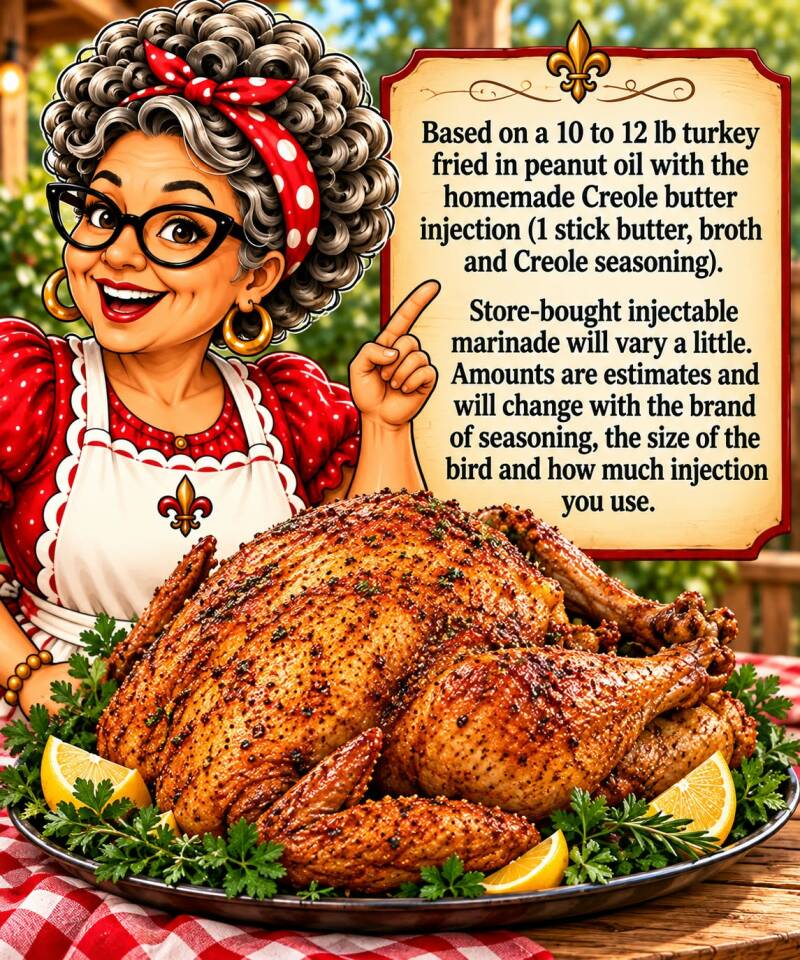
Based on a 10 to 12 lb turkey fried in peanut oil with the homemade Creole butter injection (1 stick butter, broth and Creole seasoning). Store-bought injectable marinade will vary a little. Amounts are estimates and will change with the brand of seasoning, the size of the bird and how much injection you use.
Frequently Asked Questions
Is it safe to deep fry a turkey?
It can be done more safely, but it's one of the riskiest ways to cook. UL and NFPA actually advise against oil-based turkey fryers. If you fry, do it outdoors, on level ground, with a thawed and dried bird, a measured amount of oil, the burner off while you lower the bird, and a grease-rated fire extinguisher nearby. Never leave it unattended. An oil-less (infrared) fryer is the safest option.
How much oil do I need to fry a turkey?
Use the water test: set the turkey in the empty pot, add water to cover, remove the turkey and measure or mark the water. Then dry the pot completely and fill with oil to that line, but never above the fryer's MAX fill line. Usually it's 3 to 5 gallons, depending on the pot.
What size turkey is best for frying?
USDA says up to 12 pounds. Fire-safety guidance suggests 8 to 10 pounds is best and to pass on anything over 12. This recipe is written for a 10 to 12 lb bird; if you're nervous, go smaller. A smaller bird fits the pot better, cooks evenly and is easier to lift.
How long do you fry a turkey?
About 3 to 5 minutes per pound at 350°F, so a 10 to 12 lb turkey is roughly 30 to 60 minutes. Always confirm with a thermometer.
What temperature should the turkey be?
At least 165°F in the thickest part of the breast and the innermost part of the thigh and wing. Check after you lift it from the oil.
Can I fry a frozen or partly frozen turkey?
No. A turkey must be completely thawed and dry. Ice or water in hot oil can cause a violent boil-over and fire.
Can I use a stuffed turkey?
No. USDA says don't stuff a turkey you're going to deep fry. Make the dressing separately.
What oil is best, and what if someone has a peanut allergy?
Peanut oil is traditional because of its high smoke point, but it can trigger a serious allergic reaction. For guests with a peanut allergy, use another oil with a high smoke point, such as refined canola or soybean oil, and always ask guests about allergies first.
How far ahead can I thaw and marinate?
Thaw in the refrigerator about 24 hours per 4 to 5 pounds. Marinate 12 to 24 hours in the refrigerator.
What do I do if the oil catches fire?
Never use water. Turn off the burner only if you can do so safely, use a grease-rated extinguisher, and call 911. If you can't control it right away, get everyone away from the fire and call 911.
Can I reuse the oil?
Yes, if it's cooled completely, strained and stored covered. USDA says to use it within about a month, and to discard it if it smells off or looks dark or foamy.
A Note From NanaTee — How We Do Things in South Louisiana
Honey, if you're new here, let me tell you — we do things a little differently down here in South Louisiana.
We don't measure with perfect spoons, we measure with our heart. We cook with butter when we probably shoulda used a little less. We talk loud over the pot, we hug longer than folks are used to, and we make enough food for 20 when only 10 said they comin' — because somebody always brings somebody else, and there's always room for one more chair at our table.
That shrimp mold? That bourbon pie? That deep-fried turkey? That's never just food, baby. That's love language. That's me sayin' "I was thinkin' bout you while I was stirrin' this." That's my mama in my hands, and her mama before her.
The holidays down here ain't about perfect decorations or perfect gifts. It's about togetherness. It's the cousins in the kitchen stealin' a taste, the babies underfoot, the old stories told for the 100th time that we still laugh at like it's the first.
It's family bonds, cher — the kind that hold you together when life tries to pull you apart. That is what is special. That is what matters.
And I know — I know not everybody has that. The holidays can be real hard. The house gets too quiet. The chair stays empty. You smile for folks but your heart feels heavy and lonely.
If you are feelin' that way this season, I want you to hear your Nana Tee: You are not alone, baby. You are loved more than you know. And it's okay to not be okay, and it's okay to reach out.
If you need someone to talk to, please call or text — someone is there, day and night:
Call or text 988 — Suicide and Crisis Lifeline — 24 hours, you can talk to a kind person anytime
Text HOME to 741741 — Crisis Text Line — text with a counselor anytime
Call or text 1-800-985-5990 — SAMHSA Disaster Distress Helpline — if the holidays bring up old hurts
For older folks feeling isolated: the Friendship Line, 1-888-670-1360 — they love to just talk, any time, day or night
In Louisiana, you can also dial 211 to be connected to help close to home.
You matter to this world, cher. You matter to me.
So let's be together for a little while. That's how we do it in South Louisiana.

Add comment
Comments